Search has changed. It happened quietly at first, and then it hits us all at once.
Queries are getting longer. Patience is getting shorter. And like most areas of modern life, people want answers immediately, not five clicks later.
Today’s search engine results pages (SERPs) are denser and more crowded than ever, filled with AI Overviews, featured snippets, FAQs, knowledge panels, and only then the traditional list of blue links.
That shift has expanded how brands need to think and talk about online visibility. So before we get too deep into things—and for those looking for an instant answer—let’s define some terms:
You can actually see the functional differences between these three on a given SERP (Search Engine Result Page)
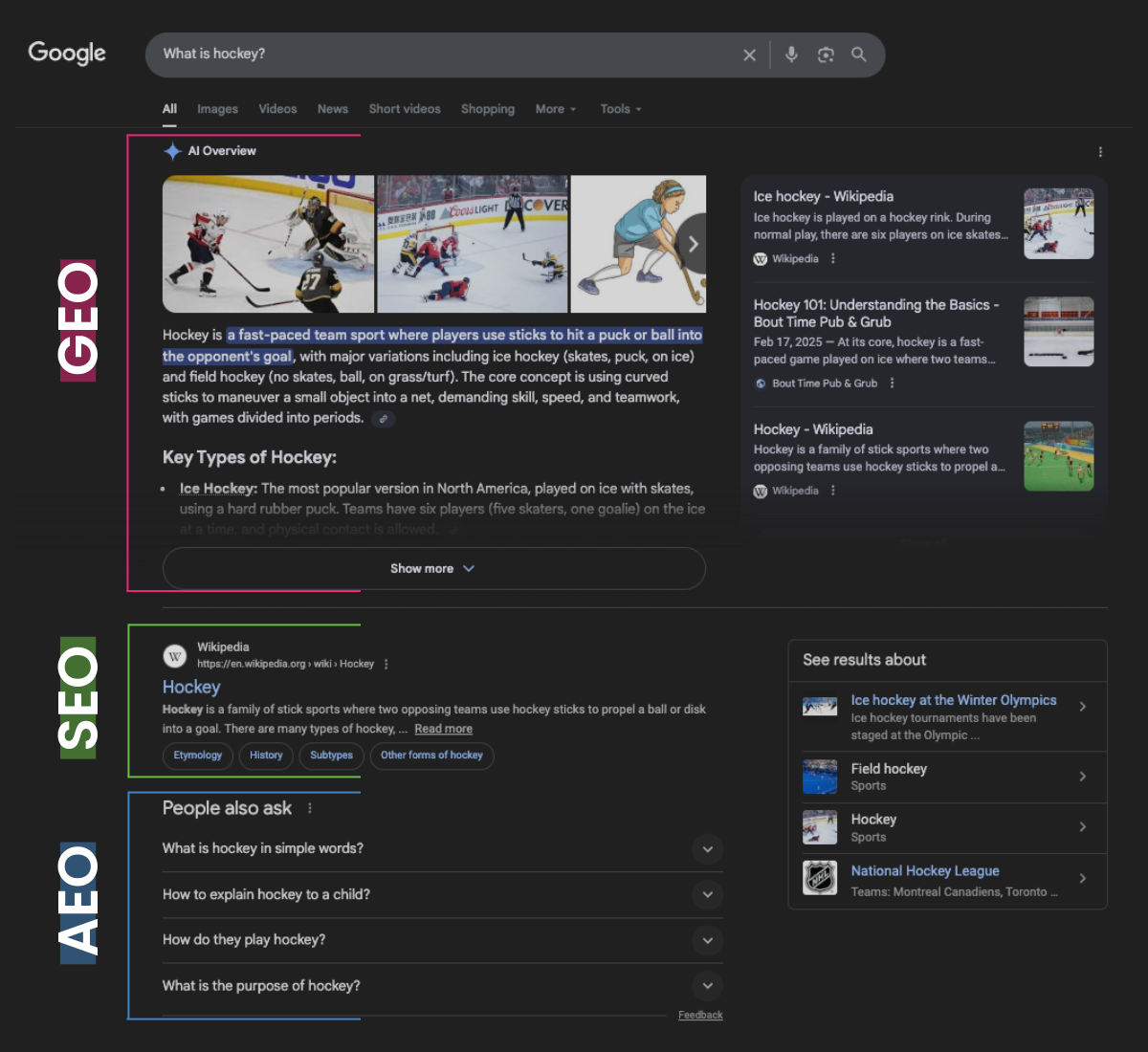
If you’re looking for a deeper understanding of how these disciplines are related, overlapping, and increasingly inseparable, read on!
Search Engine Optimization (SEO) is the practice of optimizing your website and content so it ranks organically in search engines like Google—and Yahoo! and Bing, if you know people using those, too.
At its core, SEO is about relevance, authority, and accessibility. When done well, SEO helps search engines understand:
SEO has always been part technical discipline, part content strategy, and part trust-building exercise. While tactics evolve, the goal remains consistent: make your site the best possible result for a user's queries.
Effective SEO is about aligning with how users search and how search engines evaluate content. Here are the foundational components that still matter most:
Every query has intent behind it: informational, navigational, transactional, or exploratory. Ranking requires understanding why someone is searching, not just what they typed. Pages that clearly satisfy intent outperform those that simply target keywords.
Your content should be easy for people to read and easy for search engines to parse. That means clear headings, logical structure, concise paragraphs, and descriptive internal links all improve how content is understood and indexed.
Technical health matters. Your website should load quickly, have mobile-friendly layouts, and clean HTML code to improve user experience (UX). All of these elements help search engines crawl your site efficiently. Poor performance here can undermine even the best, most informative content.
Links from credible, relevant websites act as signals of authority. While quantity once dominated SEO thinking, quality and context now matter far more. Trust is earned, not manufactured. We’re looking at you backlink spammers…
Search engines pay attention to how users interact with your site. Pages that encourage time on page, scrolling, and meaningful engagement send positive signals about relevance and quality.
SEO success today is cumulative. It’s built through consistency, clarity, and long-term investment.
Answer Engine Optimization (AEO) is the practice of structuring content so search engines can easily extract and display direct answers to user questions.
Think featured snippets, FAQ dropdowns, “People Also Ask” sections, and voice search responses. AEO focuses less on ranking a page and more on being the answer.
As search behavior shifts toward question-based queries—especially with the prevalence of voice search—AEO has become essential for visibility above traditional results.
AEO builds on strong SEO foundations but emphasizes clarity, structure, and explicit answers. Here are AEO’s foundational components:
Clear headings, bullet points, numbered lists, and concise definitions make it easier for search engines to extract information. Content that is scannable for humans is often easier for machines to interpret.
Structured data is a standardized way of labeling content so search engines understand what it represents. Using schema markup (such as FAQ, How-To, or Article schema) helps search engines confidently surface your content as an answer.
Accuracy, citations, author credibility, and up-to-date information matter more than ever. Answer engines favor sources that demonstrate expertise and reliability.
AEO works best when content directly mirrors how questions are asked. Clear “what,” “how,” and “why” phrasing increases the likelihood that your content is selected as the definitive response.
If SEO helps users find your site, AEO helps them get answers without friction.
Generative Engine Optimization (GEO) is the emerging practice of optimizing content so it is referenced, summarized, or cited within AI-generated responses.
Unlike SEO or AEO, GEO doesn’t focus on ranking positions or snippets. It focuses on influence: how your brand and content shape the responses produced by generative systems.
These systems synthesize information from across the web, prioritize authority, and look for signals of originality and expertise.
GEO is still evolving, but early patterns are clear.
Generative engines favor content that adds something new. Unique insights, firsthand expertise, proprietary frameworks, and original analysis are more likely to be incorporated than generic summaries.
AI systems rely on comprehensive explanations. Content that thoroughly covers a topic—without fluff or gaps—signals authority and reliability.
Brands that consistently publish high-quality content around a specific subject area are more likely to be recognized as authoritative sources. Depth over breadth.
It’s important to acknowledge that GEO is a growing discipline. Best practices will continue to evolve as AI models change. But the direction is clear: surface-level content will struggle, while thoughtful, expert-driven content will compound in value.
SEO, AEO, and GEO serve different functions—but they are deeply interconnected.
The key insight: best practices in one area support the others.
Clear structure improves SEO and AEO.
Strong authority supports SEO, AEO, and GEO.
Original, high-quality content fuels all three.
Rather than treating them as separate strategies, modern search visibility requires an integrated approach. Brands that focus on clarity, credibility, and user-first content are best positioned, no matter how search continues to evolve.
Search will keep changing. The fundamentals of good content, however, will remain consistent.

Proudly Based in
Evanston, IL
1744 Oak Avenue
Evanston, IL 60201


